Originally posted on SLG Analytica
Original Article: Alexey Volinets / Translated by @GBabeuf
There is a common and long-standing notion that Russia and the Russian government are comparable to “Byzantium” and “Byzantine ways.” Meaning: bureaucracy, intrigue, everything behind-the-scenes and all that. Such comparisons arise here and there quite often. Both inside Russia and outside of it—in the West. The West, the heir to the Crusaders who once plundered Constantinople, actually originated the idea of Byzantium, the former “Second Rome”, as something rather dark, bureaucratic, despotic and steeped in intrigues.
But here we aren’t talking about the West and its phobias and Russophobia, but about the constant comparison of Russia with this imagined “Byzantium”. “The Byzantine tradition is to weave intrigues, not to work,” the home-grown liberal Remchukov [Konstantin Remchukov, Editor-in-Chief and CEO of Nezavisimaya Gazeta –ed.] tells us in regard to Russian reality on the pages of the American political magazine The National Interest. Well, it is quite understandable what interests the Remchukovs and their Western patrons have… I cite this sentence only as another example of the long-stereotyped comparison of modern Russia with ancient Byzantium.
I would say that such comparisons are born from a traditionally poor knowledge of history. After all, if you look at the known facts of history, then the real Byzantium was not so much the behind-the-scenes intrigues of bureaucrats, but rather the completely open struggle of professional military men. Starting from the emperors Justin [r. 518-527 AD –ed.] and Justinian [r.527-565 AD –ed.], who came to the throne straight from the soldier’s camp, through the era of John I Tzimiskes [r.969-976 AD –ed.], the victor over the Kievan prince Svyatoslav [Svyatoslav I, Prince of Kievan Rus’ r.945-972 AD –ed.], and right up to the very end of the empire, there were not so much bureaucratic intriguers on the throne as there were brutal professional warriors. The last Byzantine emperor, as you know, fell in battle, sword in hand.
Roughly speaking, it would be correct to compare Russia with Byzantium if Yevgeny Prigozhin had become our president. Transfers of power and the accession of new dynasties as a result of military rebellion are a typically Byzantine story. A successful and dashing commander who ascended the throne by force of arms is typically Byzantine. But for Russia—both past and present— this is not at all typical.
So no, our current Rus’ is not “Byzantium”. And even more so it is not the Horde. Our enemies are very fond of this comparison when they want to directly insult us. There is nothing offensive in comparisons with the great Genghis Khan or Batu Khan (who easily defeated half of what was then Europe), in comparison with the commanders who were victorious from Hungary to Vietnam. Nonetheless, modern Russia has nothing in common with the said Horde.
Of course, more than five centuries ago the Golden Horde heritage had a strong influence on Muscovite Rus’. But of course there is nothing to compare between that nomadic army, which once upon a time became a semi-nomadic empire, and modern Russia—no matter how hard you try. There are even less similarities here than with the imagined “Byzantium”.
But still, let me tell you a secret: there is, indeed, a state in history that is very similar to the modern Russian Federation. Indeed, the modern Russian Federation is painfully similar to this state from the glorious and dark past.
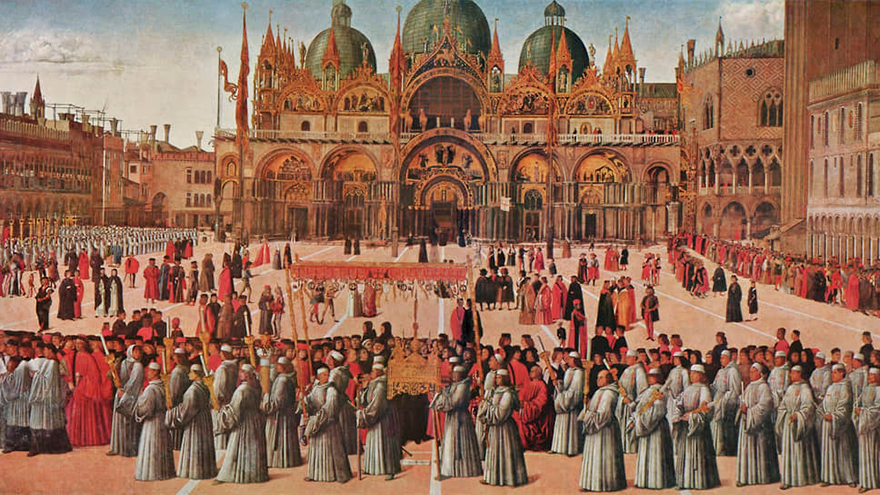
So, allow me to introduce someone whom we today very much resemble: La Serenìsima Repùblega de Venèsia, The Most Serene Republic of Venice. The most serene—well, almost as serene as the Rus’ from our poems and chronicles.
Now let’s look and compare. Old Venice was a republic, but with a very complicated power structure—just like the modern Russian Federation. It was headed by an elected head—the “Doge”, who ruled for life. At the same time, according to custom, the Doge did not have the right to travel outside the borders of the republic or to have any property abroad.
As we see, Vladimir Vladimirovich Putin today is just like a regular Venetian Doge—he’s also in practice already a life President, he’s also not allowed to travel abroad, and with overseas property it’s already exactly the same story…
As said, the Venetian Republic’s governmental structure involved a complex and intricate system of checks and balances. A list of its supreme authorities is impressive: the Great Council, the Small Council, the Senate, the Council of Ten, the Council of Forty. And those aren’t even all of them (but they’re enough for now).
Likewise, modern Russia also has a solid system of checks and balances. Well, of course, there are sinecures as well—just as there were in mediaeval Venice. Our Federation Council is just like the Grand Council of Venice. “Twenty year old representatives of noble families could also get into the Council if they received the position of lawyer by this age or if they drew a special lot at a ceremony on St. Beard’s Day…” writes a historian about the old republic.
Now, let us recall that we had a thirty year old bearded member of the Federation Council from Karachay-Cherkessia. His name was Rauf Arashukov. Apparently he successfully grabbed someone’s holy beard and drew a lot. Then, however, he was sentenced to life in prison—well, one has to be able to hold on to the holy beard. The story itself with the imprisonment of the youngest member of the Council is quite Venetian.
And the Venetian Council of Ten, Consiglio dei Dieci, which is precisely our Security Council, was also given the responsibility of countering all internal and external conspirators and adversaries. It’s even a numerical coincidence—for most of the history of the Russian Federation, the number of members of the Security Council has been exactly ten.
“The Council of Ten was a completely closed and independent body; it did not even report to special prosecutors…” writes a historian. Well, centuries down the line, a historian will be able to write about the Security Council of the Russian Venice, excuse me, the Russian Federation.
Incidentally, Venice was one of the first states that began to fight not only with weapons, but also with words. Brochures, pamphlets and abusive tracts exposing and vilifying opponents were precisely the Venetian tradition, now alive and well and continued by the deputy chairman of our own Consiglio dei Dieci, Dmitry Anatolyevich Medvedev.
Now let’s return again to our Doge, to Vladimir Vladimirovich. If in Byzantium there were a lot of emperors made up of professional warriors and generals, then in Venice everything was different. You couldn’t find professional military men among the doges. Nonetheless, they fought a lot, but precisely as organisers, financiers and beneficiaries of the wars. However, among the Venetian doges there were many who, before taking the supreme office, were involved in what we today call special services and special operations. As we see, here too there are far more similarities between the Russian Federation and Venice than with any Byzantium, with or without quotation marks.
Formally, all citizens of the Venetian Republic had the right to vote. But thanks to its intricate system, citizens more often preferred the Venetian carnival to the Venetian elections. As we see, here too much coincides between Venice and our Federation.
— “Wait a minute,” the wise reader will exclaim, “but Venice was a merchant island republic, and Russia is a large continental power?!”
— “Hold on,” answers the no less wise author of these lines, “let’s stop and think.”
Firstly, Venice, in the era of its power, was not only a Mediterranean power, but also a power at a completely pan-European level.
Secondly, the Russian Federation today is also just a merchant island republic.
Just a superficial look at the map of our country will immediately show that the Russian Federation is an archipelago of divided islands. There is a large island in the central part of European Russia, and there are all sorts of “islands” cut off from it either by taiga and other expanses, or by political barriers. The island of Kaliningrad in the far west, surrounded by NATO—why, it’s just like Venetian Cyprus, surrounded on all sides by the hostile Ottoman Empire in the 16th century.
As an aside, Othello strangled Desdemona in Cyprus during the war between the Venetians and the Turks over this island. I would like for some black man in Kaliningrad to strangle Ksyusha Sobchak, but for Sobchak to settle there, we would need a fantasy stronger than Shakespeare’s. Yet a war there is no longer so fantastic an idea…
However, let’s return to the map of the islands of our Venice, excuse me, our Federation. The island of Crimea is still an island for us for logistical and political reasons, and not just because of the forgotten science fiction novel by Vasily Aksyonov [The Island of Crimea, a 1979 novel by Soviet dissident author Vasily Aksyonov –ed.]. Only the lazy in post-Soviet Russia don’t talk about the fact that the Far East is an isolated island in relation to Moscow. Just such islands in relation to the centre are equally Murmansk, Kamchatka and various Norilsks and Naryan-Mars. And there is even a natural island in the form of the Sakhalin region.
So the Russian Federation is precisely an island republic. And taking into account the morals of our authorities, from the Doge to the Central Bank, this is precisely a merchant republic. Where economic interests and accountants’ calculations of profits and losses are to the fore. For example, the events of 2014—the refusal to send troops to the Donbass and Novorossiya—can only be logically explained by the fact that Russia is precisely a merchant republic. After counting the likely economic losses and calculating the balance, they decided not to send in troops. Yet eventually the calculations didn’t balance out—after all, life isn’t accountancy…
Actually, this “accounting” approach of the “merchant republic” very well explains all the successes and all the failures of the modern Russian Federation. The overly “pragmatic” approaches of a merchant republic have both significant advantages as well as terrible disadvantages.
It is good that the merchant republic of Venice, with all its checks and balances, could still sometimes damn the balance sheets and instead dig in its horns, and, for example, desperately engage in a struggle with the superior empire of the Turks. This gives timid hope that our Russian Venice, excuse me, our Russian Federation, is not only Doge’s palaces on the banks of murky canals, and murky accounting. In the end, La Serenìsima Repùblega lasted much longer than both Byzantium and the Horde.



 SLAVYANGRAD.org
Discussion
Comments are closed.